

Milan is a city that rewards movement. The neighbourhoods shift character from one street to the next, the distances between things are manageable, and the transport infrastructure — once understood — is genuinely one of the more functional in Italy. But “once understood” is doing some work in that sentence. Visitors arriving for the first time often spend the early part of their stay making suboptimal choices: queuing for taxis that were unnecessary, downloading apps for services they will use once, or simply walking longer routes because the metro option was not obvious. This guide is a direct attempt to shortcut that learning curve — a practical account of how Milan’s transport options actually compare, written specifically for guests staying in a central apartment and navigating the city day to day.
The ATM network: the backbone of getting around Milan
ATM — Azienda Trasporti Milanesi — operates the metro, trams and buses that cover the city. For guests staying in a central Milan apartment, the metro in particular is the fastest and most reliable way to cover meaningful distances. Four lines serve the city, colour-coded and straightforward to navigate: M1 red, M2 green, M3 yellow and M5 lilac. The network is dense enough in the centre that most major destinations — the Duomo, the main railway stations, the university campuses, the trade fair at Rho — are within a short walk of a metro stop. A single ticket covers ninety minutes of travel across all modes and costs under two euros. A day pass, a weekly pass, or a carnet of ten trips reduces the per-journey cost further and removes the friction of buying individual tickets each time. For guests based in Repubblica, Stazione Centrale, Porta Venezia or Brera, the metro is almost always the right answer for journeys of more than fifteen minutes — faster than any surface option during peak hours and entirely unaffected by traffic.
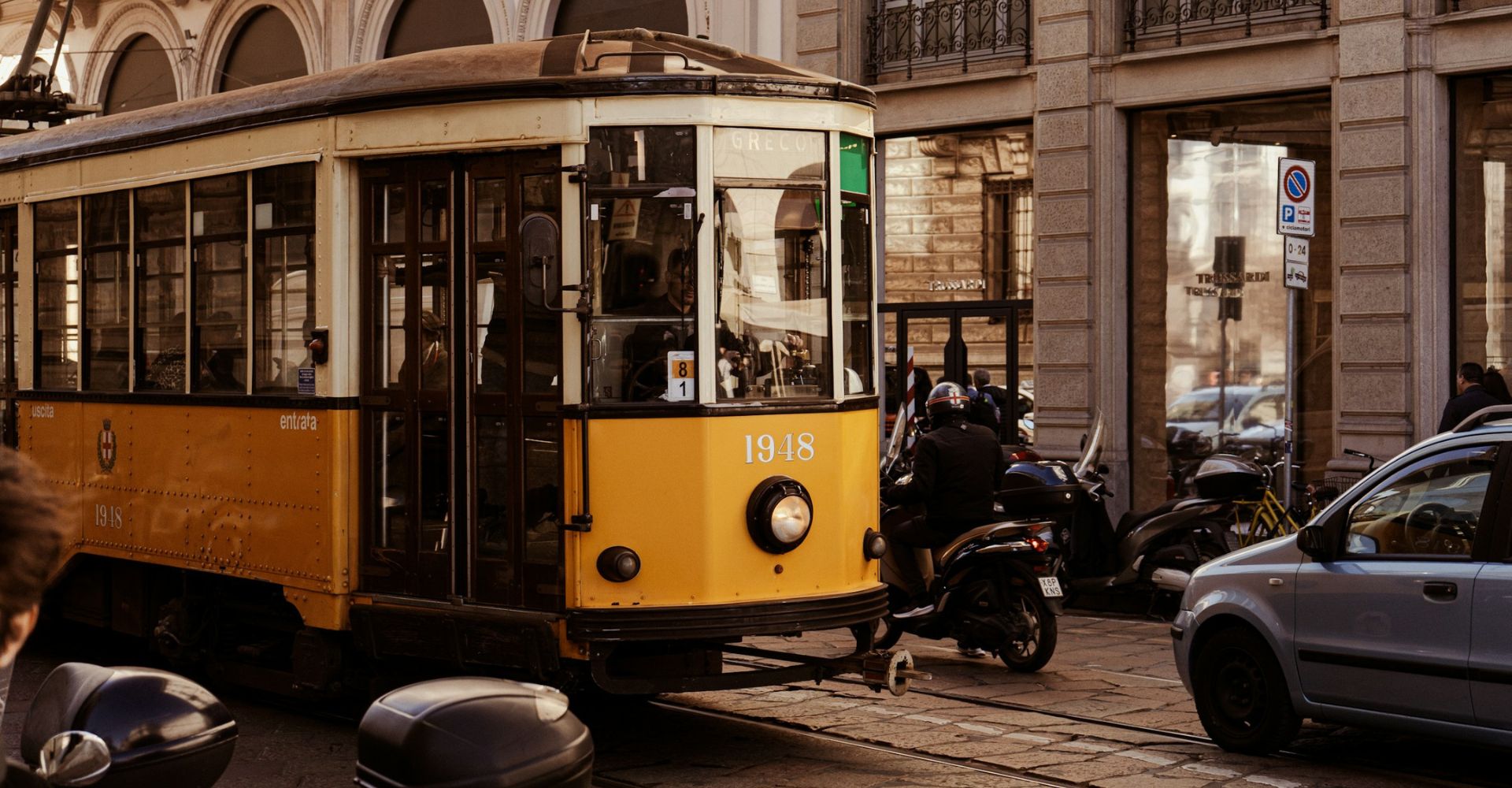
Trams deserve specific mention because they are underused by visitors and genuinely useful. Milan’s historic tram network covers routes the metro does not, runs at street level and provides a more immersive way to move through the city. Tram 9, which connects the Navigli area to Porta Venezia and beyond, is particularly useful for guests based in either neighbourhood. It runs frequently, accepts the same ATM ticket, and travels through some of the most visually interesting parts of central Milan. For short-to-medium journeys where the exact arrival time is not critical, trams are often the most enjoyable transport option in the city.
E-scooters and bike sharing: useful, but with conditions
Milan has a well-developed shared micro-mobility ecosystem. Multiple operators — including Lime, Dott and Bird for scooters, and BikeMi for bicycles — offer app-based rental across the city centre, with vehicles available at high density in the areas around Brera, Navigli, Duomo and Porta Venezia. For short trips of five to fifteen minutes — crossing from Brera to the Duomo, moving along the Navigli canale, connecting two metro stops that would otherwise require a twenty-minute walk — e-scooters are fast, cheap and available without any planning. The BikeMi bike sharing system, which includes both standard and electric bicycles, suits guests who want to cover more ground under their own power and is particularly enjoyable along the dedicated cycling infrastructure that connects the Navigli to the southern parts of the city centre.
The conditions worth knowing before relying on either option: e-scooters require a smartphone with a working data connection and a payment card registered in advance — setting this up on arrival rather than mid-journey saves frustration. Cycling in central Milan requires attention; the city has improved its cycling infrastructure significantly in recent years but the interaction between bikes, trams and cars in the historic centre demands a degree of alertness that not every visitor will find comfortable. For guests with children, neither scooters nor shared bikes are practical options, and the metro or taxi will be the more reliable default.
Taxis and ride-hailing: when they make sense and when they do not
Milan’s taxi system is metered, regulated and generally reliable — but it is not cheap, and hailing one on the street in the busier central areas can involve a wait that undermines the time saving the taxi was meant to provide. The most efficient way to use taxis in Milan is via the official app — ItTaxi — which allows booking in advance and shows estimated wait times before confirming. For airport transfers, late-night returns, journeys with significant luggage or any situation where precision timing matters, a taxi or licensed NCC (private hire) vehicle is the right tool. For everyday movement around the city during a central Milan apartment stay, it is rarely the most rational choice — the metro is almost always faster during the day and the cost difference across a multi-day visit accumulates into a meaningful sum. The exception is the first arrival from Malpensa or Linate, where a pre-booked private transfer removes the uncertainty of navigating public transport with luggage and removes the first layer of friction from what is, for many guests, the most logistically charged moment of the trip.
How your neighbourhood shapes how you move
The transport experience during a Milan stay is not uniform — it varies considerably depending on where the apartment is located, and this is worth factoring into the accommodation decision. Guests based near Stazione Centrale and Repubblica have immediate access to three metro lines and the highest density of surface transport in the city, which makes every destination feel manageable. Those in Brera and the Duomo area are close enough to the city’s main attractions to walk to a significant proportion of them, reducing the transport decision to longer journeys only. Navigli and Porta Venezia are well served by trams and surface transport, and the flat, bikeable terrain in both neighbourhoods makes micro-mobility particularly effective. Milan Retreats apartments are distributed across all of these areas — whichever neighbourhood fits the purpose and pace of the stay, the transport infrastructure surrounding it will support the visit without requiring a car, significant expense or daily planning.